
Border in Goblin stitch (fig. 210) —
Goblin embroidery is simply raised stitch , worked directly upon the pattern, with none foundation, or padding. The effectiveness of this type of embroidery, which appears so complicated and is basically very easy , and therefore the some ways during which it are often utilized, soon brought it into favors. It are often worked on the article itself, or on stripes, laid on afterwards, with a hem-stitch bordering. The original of fig. 210 was in blue and red; Blu Indigo 312 for the grounding, Rouge-Turk 321, for the setting in stem-stitch. The herring boning along the sides of the pattern, top and bottom, is additionally in red.
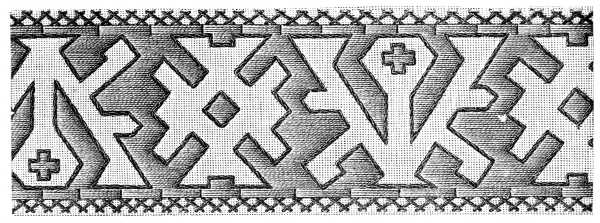 |
| Fig. 210. Border in gobelin stitch. Materials: Coton à broder D.M.C No. 35 in two different colours such as: Bleu-Indigo 312 and Rouge-Cardinal 304, Rouge-Grenat 358 and 309 or, Gris-Tilleul 393 and Rouge-Cardinal 305.[A] |
Alphabet and numerals, left blank, and outlined by the grounding, worked in Gobelin stitch (figs. 211 to 215).
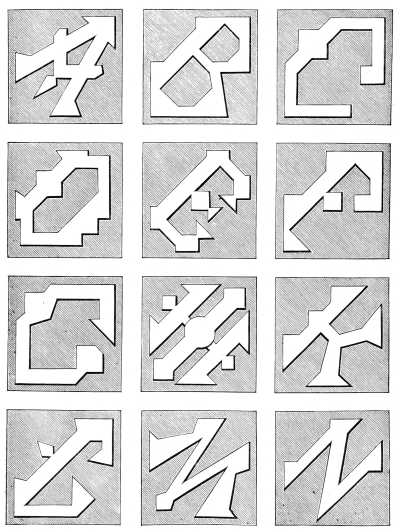 | |
| Fig. 211. Alphabet left blank and outlined by the grounding. Letters A to N. |
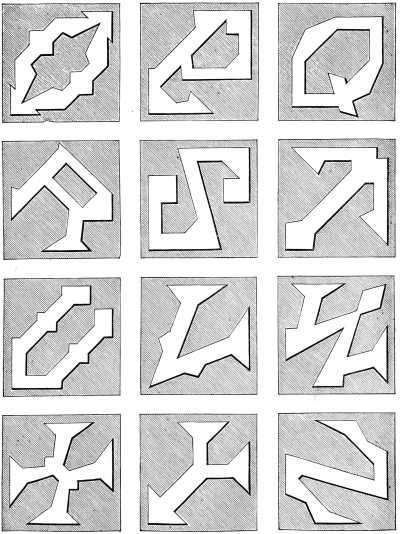 |
| Fig. 212. Alphabet left blank and outlined by the grounding. Letters O to Z.
|
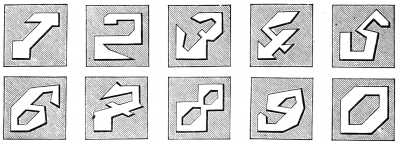
 |
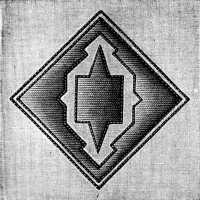
| Fig. 215. Letter W, from the alphabet given in fig. 211 and 212. |
Fig. 214 represents the numerals, executed within the same way. We should wish to draw our readers attention to a couple of other ways during which letters and numerals could also be outlined by the back-ground; for instance , the solid parts are often worked either in plain or twisted knot stitch (figs. 177 and 178); in very fine chain stitch; in old German knot or bead stitch (fig. 873), or even in piqué embroidery (fig. 877).
Border outlined by grounding, worked in Gobelin and stem stitch (fig. 216). The grounding of this pattern is worked on stiff white linen, and entirely in Rouge-Turk 321, and the outlining in Noir grand Taint 310. The same pattern can equally rather be worked on gauzes and other transparent stuffs, but with Cotton à reprise, rather than Cotton à border D.M.C, for the solid parts. Two reminder Rouge-Grenat, one dark and one Very light, could also be taken instead, or two of Jaune-Rouille, or of Violet-Mauve, employing always the lighter shade for the grounding and the darker for the setting.
 |
| Fig. 216. Border, outlined by the grounding worked in gobelin
and stem stitch. First part. |
 |
| AFig. 216. Second part. Materials: Coton à broder D.M.C No. 50.—Colours: Rouge-Turc 321 and Noir grand Teint 310.[A]dd caption |


0 Comments